DNA Replication Quiz

AP Biology - Test Your Knowledge

Student Information

DNA Replication Overview

DNA replication is the process by which a cell makes an identical copy of its DNA. This is the first step in the Central Dogma (DNA → RNA → Protein) and is essential for cell division (mitosis and meiosis) and the inheritance of genetic information.

The Semi-Conservative Model

The Meselson-Stahl experiment (1958) confirmed that DNA replication is semi-conservative.

Key Enzymes and Proteins

Enzyme/Protein Function
Helicase The "unzipper." Unwinds the DNA double helix by breaking hydrogen bonds.
Single-Strand Binding Proteins (SSBs) Coat the separated DNA strands to prevent them from re-annealing.
Topoisomerase Relieves the supercoiling and torsional strain ahead of the replication fork.
Primase Builds a short, complementary RNA primer for DNA Polymerase to start from.
DNA Polymerase III The main builder. Adds DNA nucleotides to the 3' end of the primer.
DNA Polymerase I Removes the RNA primers and replaces them with DNA nucleotides.
DNA Ligase The "gluer." Seals the nicks in the DNA backbone between Okazaki fragments.

The Process of DNA Replication

Stage 1: Initiation - Replication begins at specific sites called origins of replication.

Stage 2: Elongation - New DNA strands are synthesized. The leading strand is synthesized continuously, while the lagging strand is synthesized in short fragments called Okazaki fragments.

Stage 3: Termination - Replication ends when replication forks meet.

DNA Replication: Leading and Lagging Strands
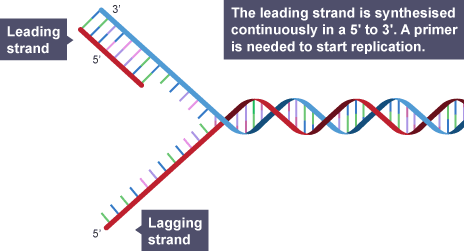
DNA Replication Diagram

DNA replication showing leading and lagging strands

Leading strand
3' 5'

The leading strand is synthesized continuously in the 5' to 3' direction. A primer is needed to start replication.

Lagging strand
5' 3'

The lagging strand is synthesized discontinuously in short Okazaki fragments, each requiring its own primer.

Telomeres and The End-Replication Problem

Telomeres are long, non-coding, repetitive nucleotide sequences at the ends of eukaryotic chromosomes that protect against the loss of genetic information during replication.

DNA Replication Quiz

Answer all 20 multiple-choice questions. Each question has only one correct answer.

1. Which experiment confirmed that DNA replication is semi-conservative?
a) Griffith's experiment
b) Hershey-Chase experiment
c) Meselson-Stahl experiment
d) Avery-MacLeod-McCarty experiment
2. Which enzyme is responsible for unwinding the DNA double helix?
a) Primase
b) Helicase
c) DNA Polymerase
d) Ligase
3. What is the function of single-strand binding proteins?
a) Unwind the DNA
b) Prevent re-annealing of separated strands
c) Add nucleotides to the growing strand
d) Remove RNA primers
4. Which enzyme synthesizes the RNA primer?
a) DNA Polymerase I
b) DNA Polymerase III
c) Primase
d) Helicase
5. In which direction does DNA synthesis occur?
a) 3' to 5'
b) 5' to 3'
c) Both directions simultaneously
d) From the centromere outward
6. Which strand is synthesized continuously?
a) Lagging strand
b) Template strand
c) Leading strand
d) Coding strand
7. Okazaki fragments are found on which strand?
a) Leading strand
b) Lagging strand
c) Both strands
d) Neither strand
8. Which enzyme joins Okazaki fragments?
a) DNA Polymerase I
b) DNA Polymerase III
c) Primase
d) DNA Ligase
9. What is the main function of DNA Polymerase III?
a) Unwind DNA
b) Add nucleotides to growing DNA strand
c) Remove RNA primers
d) Join DNA fragments
10. Which enzyme relieves supercoiling during replication?
a) Helicase
b) Topoisomerase
c) Primase
d) Ligase
11. Where does DNA replication begin in a chromosome?
a) Telomeres
b) Centromeres
c) Origins of replication
d) Promoters
12. What is the function of DNA Polymerase I?
a) Synthesize DNA
b) Remove RNA primers and replace with DNA
c) Unwind DNA
d) Join DNA fragments
13. In eukaryotes, DNA replication occurs during which phase of the cell cycle?
a) G1 phase
b) S phase
c) G2 phase
d) M phase
14. What are the repetitive DNA sequences at the ends of eukaryotic chromosomes called?
a) Centromeres
b) Telomeres
c) Origins of replication
d) Promoters
15. Which enzyme adds nucleotides to the 3' end of a growing DNA strand?
a) Helicase
b) DNA Polymerase
c) Ligase
d) Primase
16. What is the role of primase in DNA replication?
a) Synthesize RNA primer
b) Synthesize DNA primer
c) Unwind DNA
d) Join DNA fragments
17. In prokaryotes, how many origins of replication are typically found?
a) One
b) Two
c) Multiple
d) None
18. Which of the following is NOT a function of DNA polymerase?
a) Proofreading
b) Adding nucleotides
c) Unwinding DNA
d) Repairing DNA
19. The end-replication problem occurs because:
a) DNA polymerase cannot initiate synthesis
b) The lagging strand cannot be completed at chromosome ends
c) DNA becomes supercoiled
d) RNA primers cannot be removed
20. Which enzyme is responsible for extending telomeres in some cells?
a) DNA Polymerase
b) Telomerase
c) Ligase
d) Primase

Quiz Results